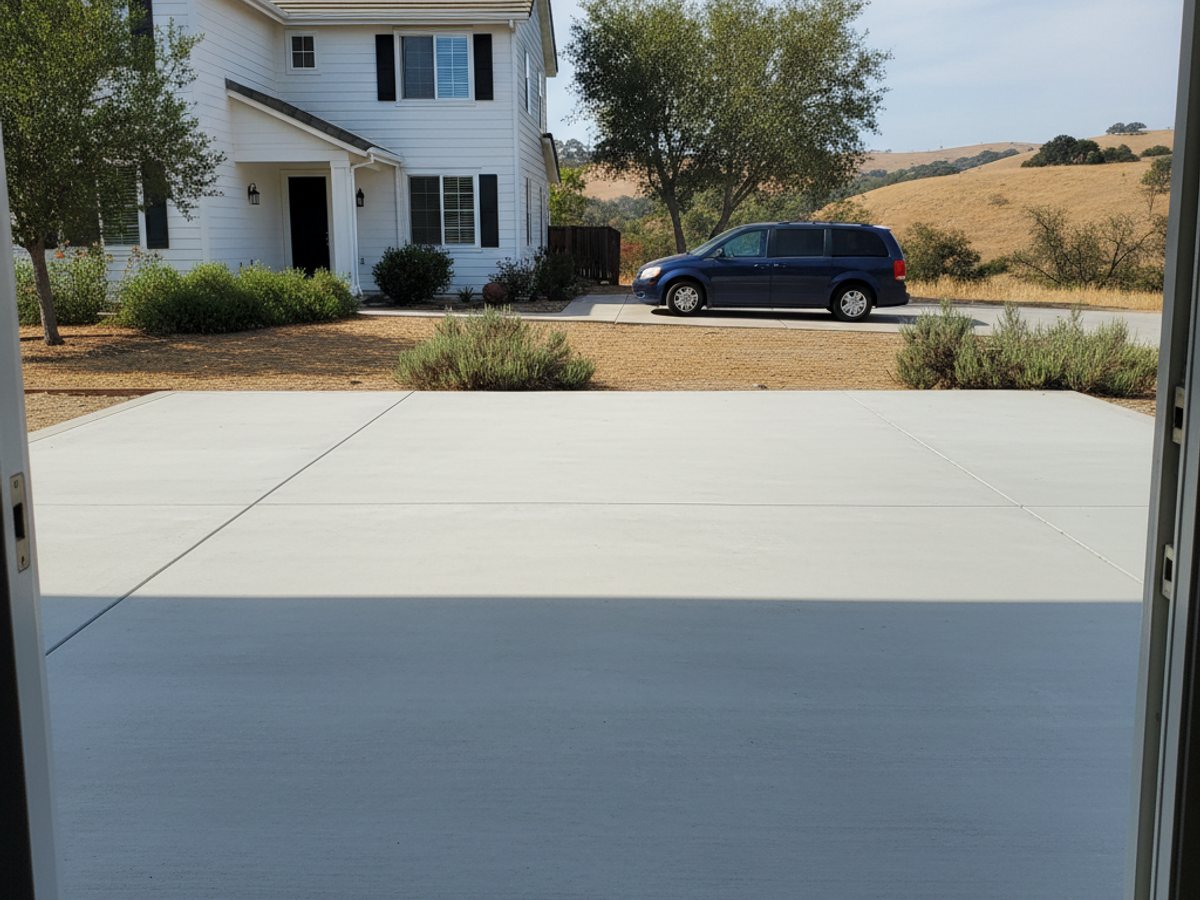
Most concrete problems in Visalia don't show up on pour day. They show up two years later, as a crack running diagonal across a driveway or a patio corner that's lifted a half inch. Almost every one of those traces back to something nobody checked before the truck showed up. Here's what actually matters, based on what this ground and this climate do to a slab over time.
What's under the dirt before you ever touch it
Visalia sits on old alluvial soil from the Kaweah River, and in a lot of neighborhoods that means clay loam with real clay content, not sand. Clay swells when it's wet and shrinks hard when it dries out, and the Central Valley gives it plenty of both. We go from soggy, saturated ground in a wet January to cracked, bone-dry hardpan by August. A slab poured on top of soil that's moving two directions a year is going to crack unless the base under it is built to handle that movement.
That's why a proper 4-inch compacted base of Class 2 road base, not just native dirt leveled off with a rake, matters more here than it would on sandy ground. Skipping it to save a day is the single most common shortcut that shows up later as cracking.
Old lines and old trees
If your house is in one of the older grids near downtown, Mooney Grove, or along Mineral King, there's a decent chance of clay sewer laterals, old irrigation lines, or even an old septic line still in the ground that nobody has a record of. Before any driveway or slab goes in, call 811 and get utilities marked. It's free, it's required, and it takes a couple of days, so don't plan it for the week you want to pour.
Tree roots are the other quiet one. Visalia has a lot of mature citrus and oak on older lots, and roots from a tree 15 feet away can still be running under where you want a walkway. A root under a 4-inch slab will lift it eventually. Either root-prune and install a barrier, or move the slab line, but decide that before, not after a crack appears next to the tree.
Thickness and reinforcement, and why 4 inches isn't always enough
A standard residential driveway in this area runs 4 inches thick for a car, but if you're parking a truck, RV, or trailer on it regularly, 5 inches with reinforcement is the better call. Reinforcement here is usually either #3 rebar on an 18-inch grid or 6x6 welded wire mesh, and honestly, rebar holds its position through the pour better than mesh, which tends to get stepped on and end up sitting at the bottom of the slab doing nothing. For patios and walkways that only see foot traffic, 4 inches with mesh or fiber reinforcement is standard.
Ask what base rock depth and reinforcement your contractor is actually planning before the forms go in. It's a fair question and a competent crew will answer it without hesitating.
Control joints and where the slab is going to crack anyway
Every slab is going to crack somewhere. Control joints are how you decide where, instead of letting the concrete decide for you. The rule of thumb is joints spaced at roughly 2 to 3 times the slab thickness in feet, so a 4-inch driveway wants joints around 8 to 10 feet apart. They need to be cut, or tooled in while the concrete is still green, within 24 hours of the pour. Wait longer than that and the slab may have already picked its own crack line somewhere you didn't plan for.
Water, grading, and where it's going to go
Visalia gets most of its rain between November and March, and when it comes it can come hard for a day or two rather than drizzling. Storm drains on older residential streets weren't built for the runoff a fully concreted modern lot produces, and a lot of neighborhoods still rely on street gutters and curb drains rather than underground storm systems. That means your slab's slope matters.
Concrete should pitch away from the house at a minimum of a quarter inch of drop per foot. A patio poured flat, or worse, sloped toward the foundation, will send water straight at your footings every winter. On a slab butted against the house, that's a foundation problem waiting to happen, not just a puddle. If your lot is naturally low or backs up to a neighbor's higher yard, this is worth a real conversation before the forms go in, not an afterthought.
Permits, setbacks, and HOA paperwork
The City of Visalia requires a permit for most driveway, slab, and foundation work, and Tulare County does the same for jobs outside city limits. Sidewalks and approaches often sit partly in the public right-of-way, which can mean an encroachment permit on top of the standard building permit. A straightforward patio replacement might not trigger much more than a phone call, but a new driveway, a retaining wall over a certain height, or anything tied to a foundation usually gets an inspection of the base and reinforcement before the pour, and sometimes a final inspection after.
If you're in one of the newer subdivisions in northeast Visalia, or out toward Dinuba or Exeter, there's a good chance you're also in an HOA with its own rules on driveway width, finish color, or how close a retaining wall can sit to a property line. Check the CC&Rs before you pick a finish or a layout. Redoing stamped concrete because the HOA didn't approve the color is an expensive lesson.
What's actually under an old slab you're repairing or replacing
If this is a repair or resurfacing job rather than new work, the big question is why the old slab failed. A slab that settled because of poor compaction underneath will keep settling if you just resurface over it. One with cracks from expansive clay will crack again in roughly the same spots. An overlay can hide cosmetic damage and give you a few more good years, but it's not a fix for a structural problem underneath, and a contractor who's honest with you will tell you which one you're dealing with before quoting the job.
The short version
Check what soil you're building on, get utilities and roots dealt with first, confirm the thickness and reinforcement match the load, get the slope right so water runs away from the house, and sort out permits and HOA approval before, not during. None of this is complicated, but skipping any one of these is how a driveway that should last 25 to 30 years starts showing problems in three. If you want someone to walk your lot and tell you straight what it needs, Spectrum Concrete Solutions handles this kind of work across Visalia and the surrounding towns.