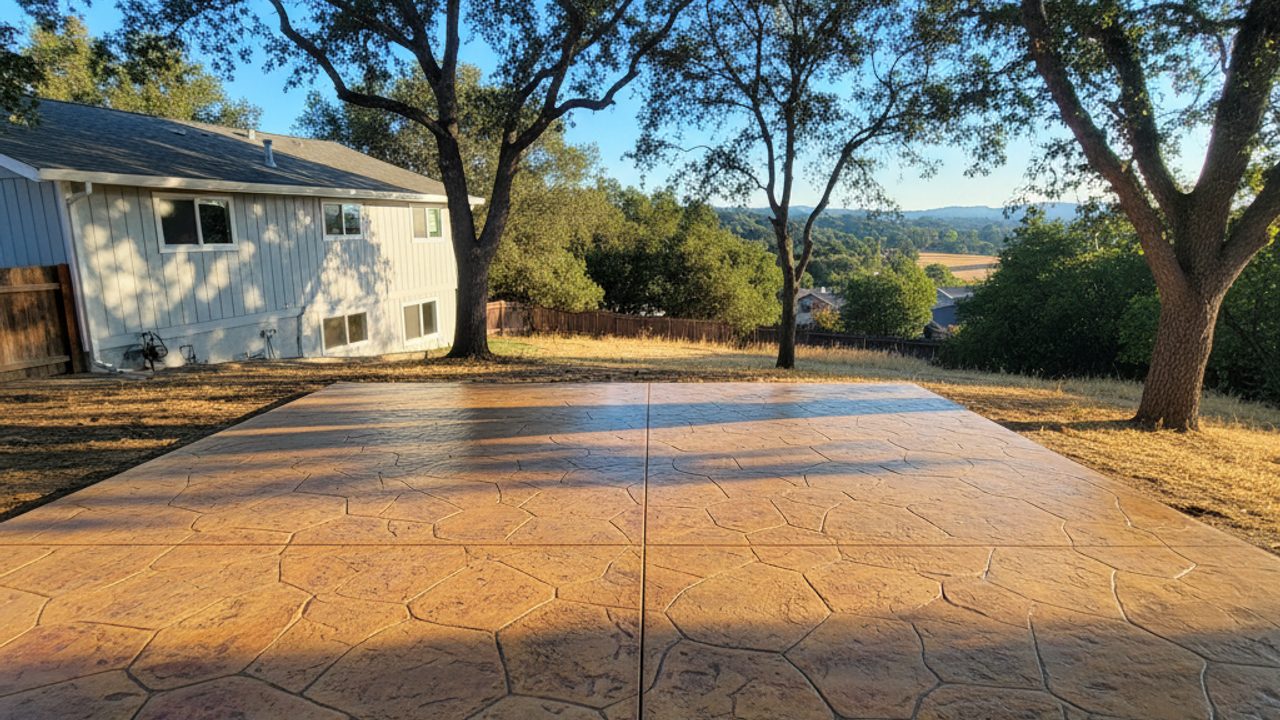
Concrete looks simple once it's down. Gray, flat, done. What you can't see is the six inches under it and the decisions somebody made about that dirt before the truck ever showed up. In Visalia, those decisions matter more than in a lot of places, because of what's actually in the ground here and what the summer does to a fresh pour.
Start with the license, not the bid
In California, concrete work falls under the C-8 contractor classification. Anyone pouring a driveway, patio, or foundation for you should be able to give you that license number without hesitating, and you can look it up yourself on the CSLB site in about thirty seconds. Check that it's active and check the bond and insurance status while you're there. A contractor who's cagey about this, or who tells you licensing is "just paperwork," is telling you something true about how the rest of the job will go too.
Ask for proof of general liability and workers' comp separately. If a laborer breaks a wrist on your property and the crew isn't covered, that liability doesn't disappear, it lands on you.
What Visalia's soil does to a slab
A lot of the ground around here is heavy clay, sometimes called adobe soil locally, and it moves. It swells when it's wet in January and February and shrinks hard when it dries out in a July heat wave. A slab poured over clay that hasn't been properly cut out and replaced with compacted base rock will crack, and not eventually, often within the first year or two. Ask what base material they're using and how deep. Four to six inches of compacted Class II road base under a driveway slab is standard around here, not optional.
Some lots, especially in older parts of town that used to be citrus groves before they were subdivided, have inconsistent fill where old tree roots and irrigation ditches were backfilled decades ago. That ground settles unevenly. A contractor who's worked in Visalia a while will know to probe for soft spots rather than just eyeballing it and pouring.
Thickness, mix, and reinforcement, the numbers to ask for
Get these in writing, not just "we'll pour it right":
- Slab thickness — 4 inches is standard for a driveway or patio, 5 to 6 inches if you're parking an RV or a heavy truck on it regularly.
- Mix strength — 2,500 psi is the low end you'll see quoted, 3,000 to 4,000 psi holds up better against the freeze-thaw swings we do get on cold winter nights and the weight of vehicles over time.
- Reinforcement — rebar (usually #3 or #4 bar on a grid) resists cracking better than wire mesh, which tends to sink to the bottom of the pour if nobody chairs it up properly during placement.
- Control joints — these should be cut every 8 to 10 feet, within 24 to 48 hours of the pour. That's not decoration, it's telling the concrete where to crack instead of letting it pick its own spot down the middle of your driveway.
The heat is a real factor here, not a footnote
Visalia summers run 100 to 105 degrees through July and August, sometimes into September. Concrete cures through a chemical reaction, not just drying out, and extreme heat speeds that reaction up too fast. Water evaporates off the surface before the slab has strength, which causes plastic shrinkage cracking, those fine spiderweb cracks you sometimes see on driveways poured in a hurry. A contractor who knows the area will pour early in the morning during summer, use an evaporation retarder or fogging on the surface, and may cover a fresh slab with curing blankets or a compound to slow the process down. If someone's planning to pour your driveway at noon in August with no plan for that, ask why.
On the other end, winter brings tule fog and cold, damp mornings, plus most of our rain in January through March. Concrete cures slower in the cold, and a surprise rain on a fresh pour before it sets can wash out the finish. A good contractor watches the forecast, not just the calendar.
Permits, and what's different old town versus new subdivision
The City of Visalia's Building Division handles permits for most concrete work inside city limits, and if you're in unincorporated Tulare County it's the county instead. A new driveway apron that touches the public sidewalk or street usually needs an encroachment permit too, since that strip technically belongs to the city, not you. A legitimate contractor pulls these themselves as part of the job and doesn't ask you to do it, or worse, skip it.
Older neighborhoods, around downtown Visalia, the Mineral King historic area, or streets built in the 1940s and '50s, often have shallow sewer laterals or old clay pipe that a crew can hit unexpectedly when cutting out a driveway or trenching for a footing. Newer subdivisions on the northeast side or around Riverway tend to have cleaner utility maps but often come with an HOA that has its own rules on driveway finish, color, or even stamped patterns. Ask early whether your neighborhood has an HOA design review, because redoing a finished driveway because it didn't match approved colors is an expensive lesson.
What to walk away from
A bid that's dramatically lower than three others usually means thinner slab, no rebar, or base prep that gets skipped entirely. You won't see the difference for a year, sometimes two, and by then the contractor's moved on. Walk away from anyone who won't put mix strength, thickness, and joint spacing in the written contract. Walk away from cash-only deals with no paperwork. And be careful with anyone promising you can drive on a new driveway the next day, real cure time for light foot traffic is around 5 to 7 days, and full strength takes close to 28 days, even though the surface looks finished long before that.
None of this is complicated once you know to ask. It's mostly a matter of getting someone who treats the dirt under the slab as seriously as the slab itself. If you're weighing a project and want a straight answer on what your ground and your budget can actually support, that's the conversation we have with people every week, take a look at Spectrum Concrete Solutions and reach out with what you're planning.